Updated: 22 September 2026
Managed Services in India from Proactive can be bought in three commercial models: CapEx (own the hardware outright, pay a separate service fee), OPEX (subscribe to hardware bundled with the management service on a 3- or 5-year term), and Managed-Only (annual service fee applied to the estate you already own). The right choice turns on refresh cycle, capital plan and control preference. The SLA and the team behind it do not change.
Every enterprise arrives at Managed Services from one of three starting points. Some are placing a fresh hardware order and want the capital purchase clean. Some want to convert IT infrastructure into a predictable monthly line and step off the refresh treadmill. Some already own a working estate and want a professional operator to take it over.
We do not push one model over another. We ask what you actually need, then we cost the three options and let the numbers argue.
CapEx. Buy the hardware. Depreciate it over three to five years. Add an annual service fee for the management layer. You own the assets, you control the refresh window, and the balance sheet sees them as capital. Suits enterprises with a capital-budget preference, a refresh cycle already funded, or governance rules that require asset ownership.
OPEX. One subscription. Hardware, management, support, all bundled into a 3- or 5-year term. Cisco owns the hardware. You subscribe to the outcome. When the term ends, you renew or refresh; there is no separate hardware refresh conversation. Suits enterprises that want a predictable operating line, that want to stop capitalising IT, or that need to scale a footprint quickly without a large upfront cheque.
Managed-Only. No hardware. Just the service. We take over your existing estate as it stands, run it under the same SLA, and handle refresh planning through your normal capex cycle. Suits enterprises that already own recent Cisco hardware and want a professional operator without renegotiating the asset side.
Different vocabulary, same shape.
| Feature | CapEx | OPEX | Managed-Only |
|---|---|---|---|
| Hardware ownership | Customer | Cisco | Customer (existing) |
| Commercial | Upfront capital + annual service fee | Single subscription fee | Annual or multi-year service fee |
| Term | Rolling annual on service; hardware refresh separate | 3 or 5 years, hardware bundled | Annual or multi-year |
| Service tiers | Essential, Essential Plus, Advanced, Advanced Plus | S1 Basic, S2 Standard, S3 Premium, S4 Signature | Essential, Essential Plus, Advanced, Advanced Plus |
| Reference hardware per tier | Any Cisco or Meraki fit | Fixed reference SKUs per tier | Whatever you already have |
| Refresh handling | Customer-led at end of asset life | Handled at term end as part of renewal | Customer-led at end of asset life |
| Balance sheet | Capital asset, depreciated | Operating expense | Operating expense on the service; asset already on the books |
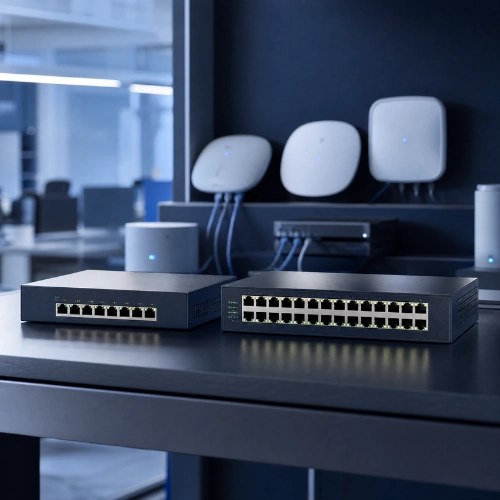
The Essential-to-Advanced Plus ladder (applied to CapEx and Managed-Only) varies coverage from business-hours to 24x7, remote-only to on-site, next-business-day to four-hour RMA. The S1-to-S4 ladder (applied to OPEX) varies the reference hardware bundle from single-user home office (S1) to a high-density office with premium Wi-Fi and 24-port PoE switching (S4).
Which Model Fits Which Enterprise?
Four questions decide most cases.
What is your capital availability this year, and next? Constrained capital points to OPEX. Comfortable capital and a preference to own points to CapEx.
What is the age of your existing estate? Under three years of remaining life points to Managed-Only. Ageing or end-of-life points to CapEx or OPEX with a refresh.
What is your governance rule on asset ownership? Public sector, BFSI and regulated pharma often require asset ownership on the books; CapEx or Managed-Only. Growth-stage and consumer enterprises often prefer OPEX for the operating-line predictability.
What is your scale and site-add rhythm? Frequent site adds (new branches, new stores, new plants) benefit from OPEX's per-site subscription bundling. A stable footprint runs cleaner under CapEx or Managed-Only.
We do not publish price lists on this page. Effective India pricing depends on estate size, tier, term length and any existing Cisco Enterprise Agreement. What we can share:
Under CapEx, the annual service fee typically sits at a defined percentage of the underlying hardware value, calibrated to tier.
Under OPEX, the subscription is priced per site or per user against the S1-to-S4 reference hardware, with the term running 3 or 5 years.
Under Managed-Only, the annual fee is calibrated to device count, tier and coverage hours, independent of asset value.
Full INR-priced illustrations sit inside the Managed Services Buyer's Kit. If you want a costed proposal on your actual footprint, the Commercial Fit Session below is the fastest way there.
The 30-minute response, 3-hour P1 restoration SLA. The 24x7 NOC in India that backs it. The NOC and SOC in one queue. The plain-language reporting. The same engineers running the estate that installed the estate. The Cisco Preferred escalation paths under the Cisco 360 Partner Program.
Model choice is a commercial decision. Service quality is not on the table.
Choosing the model before understanding the estate. We see this weekly. An enterprise decides "we are moving to OPEX" before checking whether the existing hardware has enough life to make Managed-Only cheaper for the next two years. Or an enterprise commits to a full CapEx refresh and only afterwards realises the OPEX bundle would have shipped the same hardware for a smaller cash outlay in year one.
Run the estate audit first. Then pick the model.
CapEx capitalises the asset and depreciates it over the useful life. OPEX runs as a fully expensed operating line. Managed-Only leaves the asset side unchanged and adds the service as opex. The right answer for the P&L depends on your appetite for capitalisation, your treasury view, and how the audit committee sees IT capex against operating leverage. Under new lease-accounting norms, some OPEX bundles may attract right-of-use asset treatment; your auditor is the definitive voice on that.
Ninety minutes with your IT lead and your finance lead in the same room. We map your existing estate, cost the three models against your actual footprint, model the year-one and year-three cash flows for each, and hand you a comparison document you can walk into a board meeting with. Ten working days from the session to the document.
Disclaimer: Commercial terms, tier bundles, reference hardware, pricing structures and depreciation treatment described here are indicative and subject to the final signed contract. Accounting and tax implications vary by jurisdiction and by the customer's audit position; your auditor and tax adviser are the definitive voices on capitalisation and lease-accounting treatment.

Kunal Hans CTO, Proactive Data Systems
We'll get back to you shortly.