Updated: 02 June 2026
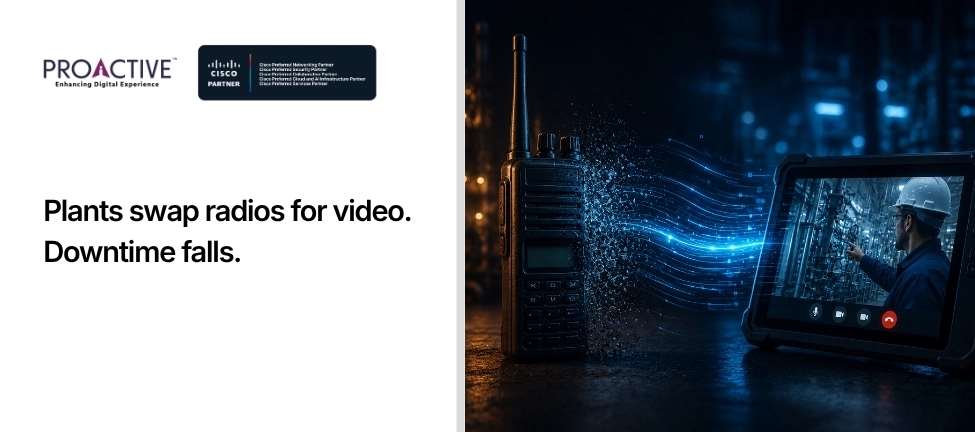
Frontline collaboration is the toolkit that connects shop-floor workers to each other and to remote experts in real time. In Indian manufacturing, it replaces two-way radios, WhatsApp groups and paper shift logs with push-to-talk on a phone, Webex Expert on Demand for hands-free video, and Webex Calling for plant-wide voice.
Around 80% of the global workforce is deskless, an estimate widely cited from Emergence Capital's connected-worker research. In Indian manufacturing, the share is even higher. These are the people who actually run the plant: operators, line supervisors, quality inspectors, maintenance engineers, and EHS leads. They are also the people who, in most factories we visit, are still on equipment that has not changed in twenty years.
Two-way radios. WhatsApp groups on personal phones. A clipboard at the shift handover. A landline in the control room. Each of these is a single, narrow channel. None of them shows a broken motor. None of them logs what was said. None of them connects to the MES or the ticketing system. Honeywell calls this "the last gap in industrial digitisation". The cost of that gap is downtime, repeat defects, slow onboarding and audit findings.
"Connected worker platform" is the Gartner-defined category that combines mobile collaboration, hands-free video, workflow guidance and analytics for deskless teams. Cisco's contribution to the category is the Webex stack, integrated with partners such as Augmentir through the Cisco SolutionsPlus programme for digitised work instructions and AI-driven worker support.
It is four capabilities, not one product.
First, push-to-talk on a phone or rugged device. A licensed Webex App user can hold a button and talk to a channel of operators on the same shift, the same line or the whole plant. The audio is logged, searchable and tied to a named identity. Radios cannot do any of those things.
Second, hands-free video to a remote expert. Webex Expert on Demand pairs the Webex App with a wearable such as RealWear, Google Glass or a smart helmet. The operator keeps both hands on the job. A senior engineer sitting in Pune sees what the operator sees, annotates the view, and pulls up the manual page on the same screen. Dairy Farmers of America, a Cisco-published reference, uses the same play to connect plant-floor workers with experts elsewhere in the network.
Third, plant-wide voice that runs on the data network. Webex Calling replaces the legacy PBX and brings extensions to every mobile and every plant phone.
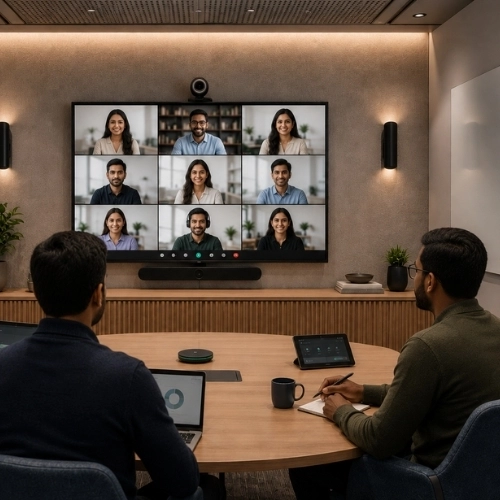
Fourth, a huddle endpoint on the plant floor. A Cisco Room Bar or Room Kit in a glass-walled bay near the shop floor turns shift handovers, downtime reviews and OEM joint troubleshooting into a structured, recorded meeting.
Teams has a Walkie Talkie feature for push-to-talk. It works. The difference is scope. Webex is built around the wider connected-worker stack: Expert on Demand for hands-free video, RoomOS endpoints for shop-floor huddles, Webex Calling for plant voice, and a single Control Hub for identity, retention and policy. Teams Walkie Talkie is a single feature inside a productivity suite. Plants that have only desk users may live with Teams. Plants that have line workers, OEM remote support and EHS evidence needs choose the broader stack.
Old way vs new way
| Plant Activity | Old Way | Frontline Collaboration |
|---|---|---|
| Operator needs help from a senior engineer | Radio call, then phone call, then engineer drives in | Hands-free video on a wearable, expert annotates live |
| Shift handover | Verbal briefing plus paper log | Recorded video huddle, searchable transcript |
| Downtime triage | Whoever shouts loudest gets attention | Push-to-talk channel, ticket auto-created |
| Quality NCR with a customer | Email and photo attachments | Video call with the line, annotated frame shared |
| OEM remote support | Site visit booked weeks out | Expert on Demand session inside an hour |
| Safety incident | Verbal report, written up later | Recorded video, time-stamped, attached to the case |
Three places, in order of size.
Unplanned downtime. Most plant downtime is not the failure. It is the wait between failure and the right person seeing it. Expert on Demand collapses that wait. A line worth Rs.20 lakh to Rs.1 crore of output an hour delivers payback within a quarter on a single line of meaningful output.
Knowledge transfer. Senior engineers retire. Recorded Expert on Demand sessions become a searchable library. New hires reach competence faster.
Audit and compliance evidence. Recorded huddles, logged push-to-talk channels and time-stamped quality calls give an auditor what they ask for. Customer audits stop being a fire drill.
EHS is the second-strongest line on the business case. A near-miss filmed on a wearable, with a time stamp, a named operator and a recorded voice annotation from the safety lead, is the artefact every Indian factory inspector and customer auditor asks for. Plants that have run frontline rollouts tell us safety reporting volume goes up and the average time to close an incident comes down, because the evidence is captured at the moment, not reconstructed afterwards.
Sixty days, one plant, one line. Week one, fix the wireless coverage (see our Wi-Fi 7 for factories guide). Week two, deploy the Webex App and push-to-talk to operators and supervisors. Week three, add two wearables and train two remote experts. Week four, install the floor huddle bay. Weeks five to eight, measure downtime, mean-time-to-resolve and OEM dispatch counts against the same line in the prior quarter. The pilot is its own business case.
Proactive Data Systems is a Preferred Partner under the Cisco 360 Partner Program across Networking, Security, Collaboration, Cloud & AI, and Services. We have deployed Webex Calling, Webex Expert on Demand and shop-floor wireless for Indian manufacturers across automotive, FMCG, pharma and heavy engineering.
Book a 60-day Frontline Collaboration Pilot. One plant. One line. Fixed scope. A measured payback report at the end. Write to [email protected].
Manav Nahar AVP, Collaboration, Proactive Data Systems
We'll get back to you shortly.