Updated: 04 June 2026
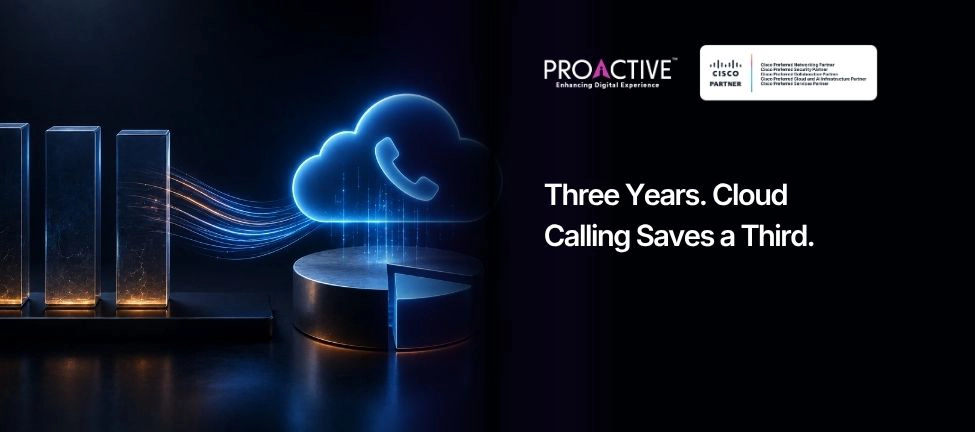
Cloud calling typically lowers a 250-seat Indian enterprise's three-year voice TCO by 30-40% against an on-prem CUCM deployment, once licence, hardware refresh, AMC, PRI termination and admin headcount are added in. The breakeven swings on the EA discount level, hybrid PSTN choice and existing phone estate.
Most India cloud-calling pages on this site explain features and definitions. This one is the three-year cost model.
Buyers compare per-user prices. Boards compare three-year costs. Once you add the on-prem items that never sit on the invoice (hardware refresh, AMC, PRI trunks, voice-gateway licences, rack space, DR, the 0.5 to 1.0 FTE who keeps it running), the picture changes.
The model below is for a 250-seat single-site Indian enterprise with an existing CUCM cluster nearing its refresh window. Numbers are illustrative INR ranges, not a quote.
| Cost Line | On-Prem CUCM (3 Years) | Webex Calling Professional (3 Years) |
|---|---|---|
| Server, gateways, IP phones | Rs.50 to Rs.80 lakh capex | Rs.15 to Rs.25 lakh (phone refresh, optional) |
| Software licences | Rs.40 to Rs.60 lakh perpetual | Included in per-user fee |
| Deployment and integration | Rs.15 to Rs.25 lakh | Rs.3 to Rs.5 lakh |
| User subscription | Nil | Rs.85 to Rs.95 lakh (250 users at standard EA discount) |
| PSTN trunks (PRI or SIP) | Rs.5 to Rs.10 lakh | Rs.2 to Rs.5 lakh via DoT-licensed handoff |
| AMC, support, patches | Rs.40 to Rs.55 lakh | Included |
| Power, rack, DR | Rs.10 to Rs.15 lakh | Nil |
| Internal admin headcount | ~Rs.22 lakh (0.5 FTE) | ~Rs.9 lakh (0.2 FTE) |
| 3-year total (illustrative) | Rs.1.8 to Rs.2.6 crore | Rs.1.2 to Rs.1.4 crore |
Ranges built from typical Indian deployments (Tier 1 or Tier 2 city, 250 seats, single site, standard SI rates) and from Cisco's published US$17 per user per month list price for Webex Calling Professional before EA discounting, FX assumed at INR 83 per USD. Over a five-year horizon, a recently refreshed CUCM cluster narrows the gap; cloud still wins on adds, moves, changes and admin load.
Avoided capex on PBX, gateway and DR boxes. Lower admin load: adds, moves and changes happen in Control Hub, freeing 40% of the week a regional admin used to spend on PBX. Plant and branch consolidation into one console. Predictable INR opex billing through Cisco's India tariff plan. Faster user adoption, because Webex Calling sits inside the same Webex App users already have for meetings and messaging. India's UCaaS market is forecast to grow in the mid-teens annually through 2028 per analyst consensus, which is why most enterprise contracts now bake in a cloud pathway even where the cluster is staying for now.
Three cases, in order of frequency. A recently refreshed CUCM cluster with four or five years of useful life and AMC paid up: the marginal cost of staying is low. A heavy contact-centre and call-recording load with a strict residency policy: hybrid is the answer. Manufacturing sites dependent on multiple resilient PRI trunks for safety-critical voice: keep the on-prem gateway architecture for now.
Teams Phone is the real alternative on most India SERPs, bundled with E5 or sold as Calling Plans, Operator Connect or Direct Routing. The TCO logic in this piece travels. The same DoT-licensed carrier handoff is required either way, and the licence stack-up (E3 plus Phone System plus Calling Plan) often surprises CFOs. Choose the platform on user experience, contact-centre integration and existing collaboration estate, not on headline list price.
Webex Calling supports Local Gateway, which terminates PSTN through a DoT-licensed Indian carrier (UL or UL-VNO licensed) while users sit on the cloud platform. The local number, the local SIP trunk and the local recording obligation stay in country. The user experience, the admin console and the licence model move to the cloud. The CUCM cluster shrinks as users leave it, and is decommissioned at the next AMC renewal.
This is the path most Indian enterprises take. Knowledge workers first, then branches, then plants, then the contact centre.
What Does an Honest 90-Day Migration Look Like?
| Wave | Activity | Days |
|---|---|---|
| 1 | Number and DID inventory, phone model audit | 1 to 10 |
| 2 | Carrier handoff design with DoT-licensed Indian SIP provider | 10 to 25 |
| 3 | Webex Control Hub integration with SSO and SCIM | 25 to 35 |
| 4 | Pilot 25 users on one floor, validate quality and emergency calling | 35 to 50 |
| 5 | Cutover in waves of 50, old cluster live as fallback | 50 to 80 |
| 6 | Decommission planning and 30-day post-cutover monitoring | 80 to 90 |
Proactive Data Systems is a Preferred Partner under the Cisco 360 Partner Program across Networking, Security, Collaboration, Cloud & AI, and Services. We size, migrate and run Webex Calling estates for Indian enterprises in BFSI, manufacturing and ITeS, and we run the Local Gateway designs that keep PSTN onshore.
Book a Cloud Calling TCO Workshop. Ninety minutes. Your seat count, your number estate, and your existing CUCM contract. A three-year TCO model in INR within ten working days.

Kunal Gill Head, Cloud Calling Practice, Proactive Data Systems
We'll get back to you shortly.