
Updated: 10 June 2026
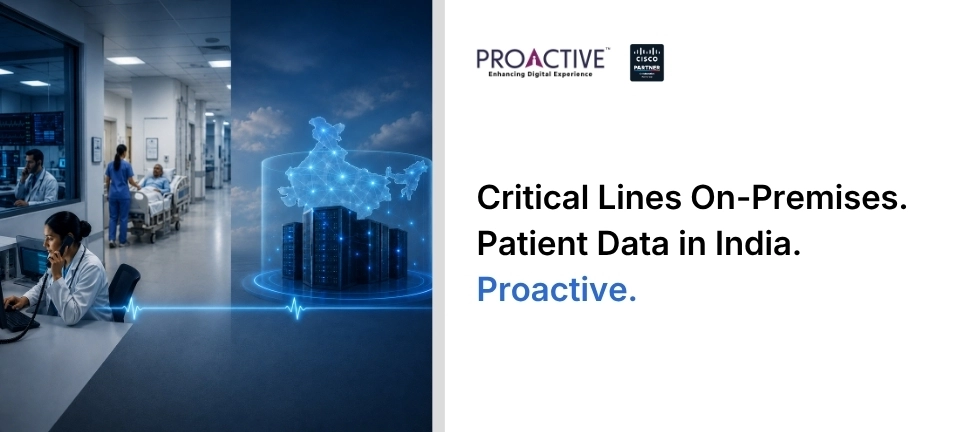
In short: Hybrid cloud calling for healthcare keeps critical clinical lines, such as nurse stations and emergency desks, under call control on the hospital's premises, so they work through an outage, while admin and back-office teams use the cloud. Patient call data stays in Indian data centres. Webex Calling is the only platform built this way.
At three in the morning on a ward, a nurse presses a button and a phone rings at the station. Nobody in that moment is thinking about cloud architecture. They are thinking about a patient. Which is exactly why you, the person who signs off the phone system, have to think about it for them. That duty is the case for hybrid cloud calling for healthcare.
A hospital phone is not an office convenience. It is a clinical instrument. The line between a ward and the emergency team, between the lab and the consultant, between a worried family and the front desk, carries decisions that cannot wait. The Joint Commission has long found communication breakdowns to be a leading root cause of serious clinical errors (NCBI, Patient Safety and Quality, AHRQ). So ask yourself the question a cloud-only vendor will not raise. When the internet to your hospital drops, what happens to the calls that keep patients safe?
The Architecture in Plain Terms
It is the design that stops a hospital from having to choose between safety and modernisation. You keep call control on the premises for the lines that cannot fail, nurse stations, the emergency desk, clinical coordination, so they keep working even if the link to the cloud goes down. You move the rest, administration, appointment booking, billing, back-office teams, to the cloud, where agility and remote work matter more than local survival. One console manages both, so your hospital telephony runs as a single system across wards and back office, as we set out in the architecture explainer.
This is the per-site, per-function freedom at the centre of hybrid cloud calling, applied where the stakes are highest. A booking team can live entirely in the cloud. A casualty ward should not. For the broader healthcare picture, see our guide to cloud calling for hospitals. Webex Calling is the only platform that lets you draw that line and keep it.
A cloud-only phone system puts call control in a data centre somewhere else and connects your hospital to it over the internet. On a good day, you never notice. On the day a cable is cut, a storm takes the link, or the power flickers, every phone that depends on that connection goes quiet at once. In an office, that is lost productivity. On a ward, it is a patient-safety event.
| For A Hospital | Cloud-only | Hybrid |
|---|---|---|
| Emergency and nurse-station lines in an outage | Stop | Keep working on site |
| Clinical call control | In the cloud | On your premises |
| Admin and booking teams | Cloud agility | Cloud agility |
| Patient call data | Often offshore | Stored in India |
Keeping clinical call control on the premises removes that single point of failure for the lines that matter most. The ward still reaches the emergency team. The front desk still works. The cloud, when it returns, picks up where it left off. You can read more on this resilience choice in why hospitals keep call control on-premises and on survivability more broadly.
Reliability is half the duty. The other half is the data those calls create. A recorded conversation with a patient, a voicemail about a test result, a call log tying a name to a condition, all of it is sensitive personal data, and healthcare is the most expensive sector in the world to get this wrong. IBM puts the average healthcare data breach globally at $9.77 million, the costliest of any industry for the fourteenth year running, while India's average breach across all sectors hit a record ₹19.5 crore the same year (IBM, Cost of a Data Breach 2024; IBM India).
India's Digital Personal Data Protection Rules, notified in 2025, treat health data with particular care and set a clear runway for how you store and handle it. For hospitals already working to NABH standards and aligning with the Ayushman Bharat Digital Mission's approach to health data, keeping patient voice data in-country is part of the same obligation, not a separate project. A phone system that ships call data to servers abroad turns a clinical tool into a compliance exposure. Webex Calling stores recordings, call detail records and logs in dedicated Indian data centres in Mumbai and Chennai, which keeps patient voice data in-country and makes your compliance position a line in the design rather than a finding in an audit. For the detail on where calls are held, see our note on India data residency. Where does your hospital's call data sleep tonight, and could you prove it by morning?
The platform is Cisco's. A hospital deployment, where you cannot take a ward offline to test a theory, depends on the partner. Picture a hospital group running sites in Chennai and Coimbatore. Casualty and nurse-station lines keep call control on the premises and answer through a power cut, while booking, billing and back-office teams move to the cloud, and the cutover runs ward by ward so no department goes dark. That is the shape of a deployment done with clinical continuity in mind.
Proactive is a Cisco Preferred Collaboration Partner holding all five Cisco portfolios, with more than 10,000 users live and a record of zero failed migrations, and has replaced legacy systems with Webex Calling across healthcare clients in India. After go-live, Managed Cloud Calling keeps the system monitored and owned, so a 2am fault reaches the team that built it, not a queue.
So before you accept any vendor's "move it all to the cloud", put the hospital test to them. If the link to this building fails, do the emergency lines still ring, and can you tell me, in one sentence, which country my patients' call data sits in? If either answer wavers, you have found the reason healthcare runs on hybrid.
Book a Cloud Calling Assessment, and we will map which of your lines belong on-premises and which belong in the cloud.

Manav Nahar AVP, Collaboration, Proactive Data Systems
We'll get back to you shortly.
