
Updated: 11 June 2026
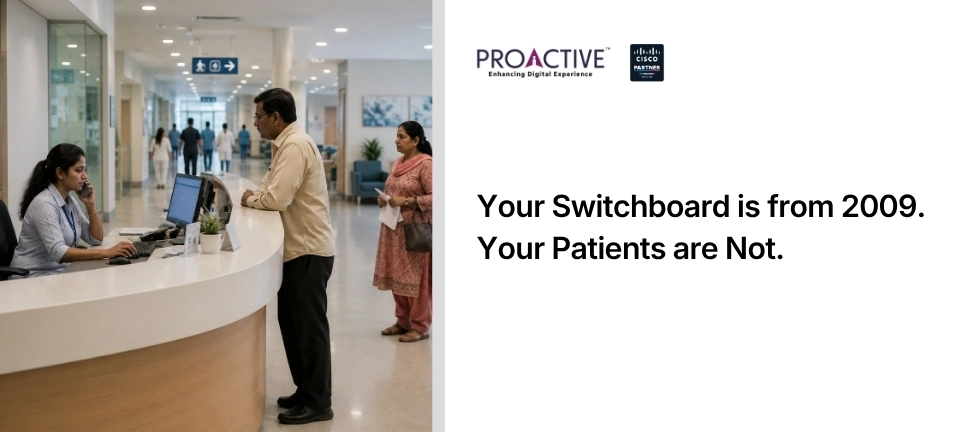
In short: Cloud calling for hospitals replaces a hospital's legacy exchange with one cloud-managed phone system across every department and site. Staff reach each other by extension, doctors take calls on the move, patient lines get contact-centre tools, and critical lines and patient data can stay on Indian soil, all run from a single console.
Walk into any large hospital in India, and you will find a switchboard from another decade still holding the place together. A receptionist patches a frantic caller to a ward, takes a message for a consultant who left an hour ago, and tries three extensions to find a free bed. Every one of those seconds is a patient waiting. Cloud calling for hospitals in India exists to give those seconds back.
This matters more each year because hospitals are growing faster than their phone rooms. India's hospital sector is set to sustain 11 to 12% annual growth, driven by rising insurance and medical tourism (CareEdge, via IBEF). More beds, more sites, more patients on the line, all routed through an exchange that was never built for it. So here is the question for the people running the hospital, not just the IT room. When a patient or a colleague needs to reach the right person now, how many seconds does your phone system cost them?
The Architecture in Plain Terms
Cloud calling replaces the on-site exchange with one phone system run from the cloud and managed through a single console. For a hospital, that means the switchboard, every ward, the labs, the pharmacy, the back office and any sister site stop being separate phone islands and become one network. Anyone reaches anyone by extension. A new wing or a new clinic switches on without wiring a fresh exchange. And the people who are never at a desk, the doctor on rounds, the coordinator crossing the campus, carry their hospital number on a mobile.
This is the broad move. The sharper decisions sit inside it: whether to keep critical lines running through an outage is the resilience question we cover in hybrid cloud calling for healthcare, and how to handle recorded patient conversations is the compliance question we cover in patient data and call-recording under DPDPA. This page is about the whole: a hospital that can hear itself and answer its patients.
No organisation talks more than a hospital. Care is coordinated by voice, ward to consultant, lab to clinician, theatre to recovery. A US 36-hospital time-and-motion study found nurses spend over an hour of a day shift on communication about care, most of it with colleagues (The Permanente Journal). When the tool carrying that hour is a tired exchange and a hunt through extensions, the waste lands where it hurts most, on clinical time and on patients.
| In a hospital | Legacy exchange | Cloud calling |
|---|---|---|
| Reach an on-call doctor | Chase extensions | One number, rings their mobile |
| Add a department or site | Wire new hardware | Switch on in the console |
| Appointment and complaint lines | A phone that rings | Queued, routed, measured |
| Multi-site groups | Separate islands | One network, inter-site dialling |
| Critical lines and patient data | Wherever they land | On-premises or in India by design |
Put the whole hospital on one system, and the hunting stops. Nurse-station communication runs on the same network as the consultant's mobile and the lab's extension, so a ward reaches a specialist in one step, not three. Department extensions stay consistent across a group, so a doctor moving between two units keeps one number. Escalation paths, the calls that cannot wait, route by rule rather than by memory. The campus stops depending on a receptionist who happens to know where everyone is.
Mobility is the part legacy systems never solved. Clinicians work on their feet. With hospital telephony extended to a mobile app, a doctor takes and makes calls on the hospital number, with the same directory and recording rules as a desk phone. The hardest people to reach become the easiest.
A hospital's phones face outward as much as inward. Appointment desks, lab-result lines, billing queries and complaints are where patients judge you, often before they meet a single clinician. Cloud calling carries contact-centre tools on the same platform, so patient lines get queuing, routing by department or language, and call analytics, rather than a phone someone hopes to answer between tasks. You can see how long patients waited, how many gave up, and where the line is failing them.
What would change if you measured your appointment line the way you measure bed occupancy? That is the distance between healthcare calling that rings and a patient experience you actually manage.
Two duties sit above the rest, and a hospital cannot treat them as add-ons. Critical lines, nurse stations, casualty, clinical coordination, must keep working when the network does not, which is why you keep call control on the premises for them; the full case is in why hospitals keep call control on-premises. And patient voice data, recordings, voicemails, call logs tying a name to a condition, is sensitive personal data under India's Digital Personal Data Protection Rules. Webex Calling stores recordings, call detail records and logs in Indian data centres in Mumbai and Chennai, which keeps that data in-country and makes your compliance position a design choice.
Not every cloud phone system suits a hospital. Hold any vendor against six tests.
Score honestly against those, and the shortlist writes itself.
The platform is Cisco's. In a hospital, where you cannot take a ward down to test an idea, the partner decides the outcome. Picture a diagnostic and multi-specialty chain consolidating eight sites across Mumbai and Pune onto one network. Each centre keeps its critical lines resilient, the central appointment and report-collection lines move to a managed contact-centre queue, doctors carry one number across every site, and the cutover runs site by site so no centre stops taking patients. That is a deployment planned around patients, not around the installer's calendar.
Proactive is a Cisco Preferred Collaboration Partner holding all five Cisco portfolios, with more than 10,000 users live and a record of zero failed migrations, and has replaced legacy systems with Webex Calling across healthcare clients in India. After go-live, Managed Cloud Calling keeps the system monitored and owned, so a 2am fault reaches the team that built it, not a queue.
So before your next bed expansion outruns your phone room, ask the harder question. Are you buying a phone system, or are you finally letting the hospital hear itself and answer its patients? Growth will reward the hospitals that can. Make sure yours is one of them.
Book a Cloud Calling Assessment, and we will map your wards, departments and patient lines onto one network.

Proactive Collaboration Team
We'll get back to you shortly.
