
Updated: 19 June 2026
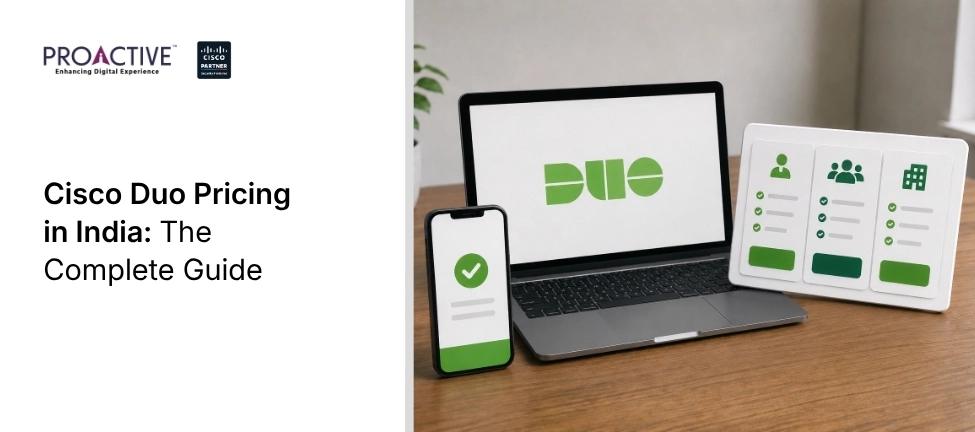
Cisco Duo does not publish list prices publicly in India. Pricing is quoted in Indian rupees through authorised Cisco partners on a per-user, per-month subscription basis. The Cisco Duo cost in India depends on four variables: user count, licensing tier, contract term, and whether deployment services are included.
In India, Cisco Duo is available through authorised partners, including Proactive Data Systems, a Cisco Preferred Security Partner, which quotes pricing in Indian rupees and provides deployment services alongside the licence.
Cisco Duo has three tiers. Each includes everything in the one below it. The tier you select is the single largest driver of per-user cost.
Duo Essentials is the lowest-cost tier. It covers multi-factor authentication, single sign-on, FIDO2 support, Verified Push, and passwordless authentication. It satisfies the core MFA requirement under CERT-In CISG-2025-02 and the RBI Authentication Directions 2025 for organisations with straightforward environments and no privileged-access audit requirements.
Duo Advantage is the most commonly deployed tier in Indian enterprise environments and is priced above Essentials. It adds device trust and adaptive authentication. Device trust checks endpoint health before granting access. Adaptive authentication adjusts the factor requirement based on risk signals, including location, device posture, and network type. For most Indian enterprises requiring full CERT-In, RBI, and SEBI CSCRF compliance, Duo Advantage is the appropriate starting tier.
Duo Premier is the highest-cost tier and is appropriate when zero trust network access is the objective. It adds Duo Network Gateway, which enables application-level access without a traditional VPN. It is relevant for organisations actively replacing legacy VPN infrastructure or implementing zero trust architecture.
The per-user monthly cost decreases as the user count increases. An organisation with 200 users pays a higher per-user rate than one with 2,000. For large deployments spanning multiple sites or a branch network, the volume pricing differential can be significant.
The user count in a Duo deployment is not the same as the total headcount. Users are defined as individuals who authenticate through Duo. A manufacturing plant with 3,000 employees but only 500 requiring system-level MFA would licence for 500 users. The credential audit conducted before deployment clarifies the actual user population. It is frequently different from the number assumed at the start of the evaluation.
Organisations that skip the credential audit and estimate user count from headcount typically either over-licence, paying for users who do not need MFA, or under-licence and face mid-contract additions at potentially different pricing.
Annual commitments are priced lower than monthly arrangements. Most Indian enterprise deployments are structured as one-year or three-year agreements. A three-year term produces a lower effective per-user monthly cost than a one-year term.
Multi-year agreements provide cost certainty for budgeting. For organisations with a defined compliance timeline — a CERT-In audit cycle, an RBI examination window, or a parent company security mandate deadline — a multi-year commitment aligned to that cycle is a common structure.
Cisco does not publish list prices publicly. Pricing in India is quoted in Indian rupees through authorised Cisco partners. GST at 18% applies to software licence subscriptions. The INR price reflects local market conditions and is agreed between Cisco and its partner network. It is not a direct currency conversion from the USD list price.
India is one of the fastest-growing markets for enterprise MFA adoption globally, driven by the simultaneous enforcement of CERT-In CISG-2025-02, RBI Authentication Directions 2025, and the approaching DPDPA full enforcement deadline of 13 May 2027. This regulatory convergence has increased demand for Cisco Duo deployments across BFSI, IT/ITeS, manufacturing, and healthcare sectors in India.
Pricing through an authorised Indian partner rather than direct procurement has practical advantages. The partner handles GST invoicing, provides support within Indian time zones, and, in most cases, includes deployment guidance with the licence. For organisations requiring on-site support, a partner with a presence in the relevant city is a practical requirement.
The licence cost is one component of the total cost. The more significant variable is deployment quality.
A Cisco Duo deployment that does not begin with a credential audit will leave gaps that a later audit or examination will find. Remediating those gaps after the fact costs more than doing it correctly at the start.
A deployment that does not configure log export to an India-resident SIEM from day one will fail the CERT-In 180-day log retention requirement. Retrofitting this after deployment requires additional professional services and risks a gap in the log record.
A deployment that does not structure the RBI compliance evidence package alongside the configuration will produce a compliant Duo installation that still fails an RBI examination. The seven-element evidence package must be built from day one, not assembled under examination pressure. Two organisations paying identical Duo licence costs can have substantially different total deployment costs over a three-year term depending on how the engagement is structured.
Five factors determine the price of a Cisco Duo deployment in India.
User count. The number of individuals who will authenticate through Duo, confirmed by a credential audit rather than assumed from headcount.
Tier selection. Essentials, Advantage, or Premier, based on compliance requirements and infrastructure complexity. Most Indian enterprise deployments land on Advantage.
Contract term. One-year, two-year, or three-year. Longer terms produce lower effective per-user monthly costs.
Deployment services. Whether the licence is quoted standalone or with a credential audit, log architecture, compliance evidence package, and deployment support included.
Support level. Ongoing support requirements post-deployment, including response time commitments and audit preparation assistance.
The most common reason for inaccurate initial quotes is an incorrect user count. A credential audit before the quote, rather than after, produces a more accurate user population figure and a more accurate price.
When requesting a quote, provide the following to your Cisco partner: approximate user count by role type (administrators, remote access users, general workforce), the systems Duo needs to protect, the compliance frameworks driving the deployment, and the preferred contract term.
Proactive Data Systems, a Cisco Preferred Security Partner, provides Cisco Duo pricing in Indian rupees, including GST, from offices in Delhi, Mumbai, Pune, Bengaluru, and Hyderabad. Every quote includes a deployment assessment based on the specific environment rather than a standard price list.

Proactive Cybersecurity Team
Quick answers to common questions about this topic.
We'll get back to you shortly.
