
Updated: 05 May 2026
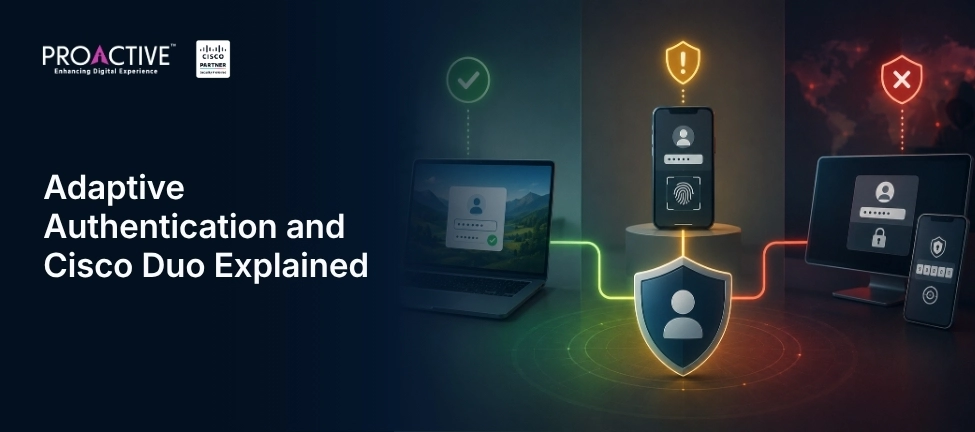
Adaptive authentication adjusts the authentication requirement based on the risk level of each access request. Instead of applying the same factor to every login, it evaluates contextual signals and responds proportionally. Low-risk logins require less friction. High-risk logins require stronger verification.
Standard MFA treats every login identically. A user logging in from their usual device on the corporate network at 9 AM receives the same push notification as an unknown device logging in from a foreign IP at 2 AM. Adaptive authentication treats those two events differently.
Cisco Duo implements adaptive authentication through its Advantage tier. The risk signals Duo evaluates include device health, IP reputation, login location relative to the user's history, network type, time of access, and whether the device is managed or unmanaged.
Based on those signals, Duo can take four actions. It can allow access with the standard factor. It can step up to a stronger factor such as Verified Push or a hardware token. It can block access entirely. Or it can prompt for additional verification before proceeding.
For Indian enterprises, adaptive authentication is directly relevant to one regulatory requirement. RBI Authentication Directions 2025 require risk-based escalation for higher-value and anomalous digital payment transactions. Adaptive authentication satisfies this requirement at the platform level.
It also addresses a practical usability concern. Requiring Verified Push or hardware tokens for every login in a large workforce creates helpdesk volume. Adaptive authentication reserves stronger factors for logins that genuinely warrant them.
Proactive Data Systems, a Cisco Preferred Security Partner, configures adaptive authentication policies as part of Cisco Duo Advantage deployments across Indian enterprise environments.

Alok Sah Head, Cybersecurity, Proactive Data Systems
We'll get back to you shortly.
