
Updated: 12 May 2026
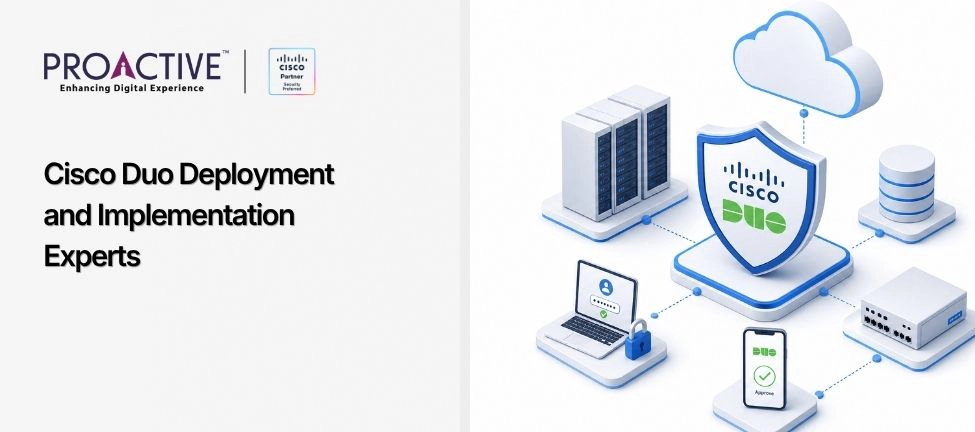
When companies begin evaluating MFA, the first instinct is to compare products.
They search for:
But experienced security leaders know the real question is different.
The question is not "Which MFA product should we buy?"
The real question is:
"How should MFA be architected across our environment?"
Because MFA deployed incorrectly can still leave critical attack paths open.
Cisco Duo is designed to protect identity access across modern hybrid infrastructure.
Common protection scenarios include:
Instead of acting as a simple authenticator app, Duo allows organisations to enforce:
These capabilities make it suitable for enterprises implementing Zero Trust security models.
A Cisco Duo partner is responsible for designing the identity security architecture that sits behind the product.
Licences are easy to buy. Deployment design is harder.
Duo vs Other MFA Platforms: Enterprise Comparison
| Capability | Cisco Duo | Generic MFA Apps |
|---|---|---|
| Adaptive authentication | Yes | Limited |
| Device trust checks | Yes | Rare |
| Policy-based access control | Advanced | Basic |
| Integration with enterprise identity | Strong | Moderate |
| Privileged access protection | Available | Often limited |
Organisations usually adopt Duo when authentication must extend beyond simple OTP verification into broader identity security controls.
A Cisco Duo partner does more than sell licences.
Enterprise deployments require several layers of planning.
Identity Architecture Design
The first step is understanding how identity currently works inside the organisation.
Typical environments include:
Each requires different integration patterns.
Application protection planning
Security teams must decide which systems require MFA protection.
Examples include:
Protecting only one access path often leaves gaps.
Rollout sequencing
MFA projects succeed or fail based on rollout strategy.
Typical enterprise rollout order:
Gradual rollout reduces user friction and support issues.
User Adoption Strategy
One of the most underestimated elements of MFA deployment is user behaviour.
Without proper communication and onboarding:
A structured rollout avoids these problems.
Attackers rarely need sophisticated exploits.
Most breaches begin with valid credentials obtained through phishing or previous data breaches.
Without MFA, attackers can attempt:
If authentication relies only on passwords, the attacker needs just one successful login.
MFA adds an additional verification layer that interrupts this attack path.
Cisco Duo Deployment Timeline
Enterprise deployment timelines typically follow this structure.
| Deployment Scope | Typical Timeline |
|---|---|
| VPN + Microsoft 365 | 1–2 weeks |
| SaaS application coverage | 2–3 weeks |
| Full enterprise rollout | 4–8 weeks |
Actual timelines depend on application landscape and integration complexity.
Even organisations that deploy MFA sometimes remain vulnerable because of design mistakes.
Common failures include:
Security architects often call this "MFA theatre" — the control exists, but attackers still bypass it.
A well-designed Duo deployment addresses these gaps through stronger policy enforcement and broader application coverage.
Enterprise deployment timelines typically follow this structure.
| Deployment Scope | Typical Timeline |
|---|---|
| VPN + Microsoft 365 | 1–2 weeks |
| SaaS application coverage | 2–3 weeks |
| full enterprise rollout | 4–8 weeks |
Actual timelines depend on application landscape and integration complexity.
Before beginning a rollout, security teams usually verify several prerequisites.
This checklist prevents most MFA deployment failures.
Proactive Data Systems has spent decades designing and securing enterprise infrastructure across India.
When organisations evaluate Cisco Duo, they often begin with a short architecture discussion covering:
These early decisions determine whether MFA becomes a meaningful security control or simply a compliance requirement.
Enterprises in Delhi NCR frequently deploy Duo to protect hybrid workforces, VPN access, and Microsoft 365 environments.
Mumbai organisations often evaluate Duo within regulated sectors such as BFSI and financial services where identity security is critical.
Manufacturing companies and global capability centres in Pune often deploy Duo to secure engineering access and vendor connectivity.
Technology companies in Bengaluru typically adopt Duo as part of broader Zero Trust identity strategies.
Proactive Data Systems has spent decades designing and securing enterprise infrastructure across India.
Security teams evaluating Cisco Duo often begin with a short architecture conversation covering:
These discussions frequently clarify deployment scope, pricing bands, and integration complexity before procurement begins.
Buying MFA software is easy.
Designing identity security correctly is harder.
Organisations that treat MFA as an architectural decision rather than a simple purchase usually achieve stronger security outcomes.
Before committing to licences, a short architecture discussion often clarifies rollout strategy, integration scope, and long‑term identity security design.

Proactive Cybersecurity Team
Quick answers to common questions about this topic.
We'll get back to you shortly.
