
Updated: 11 May 2026
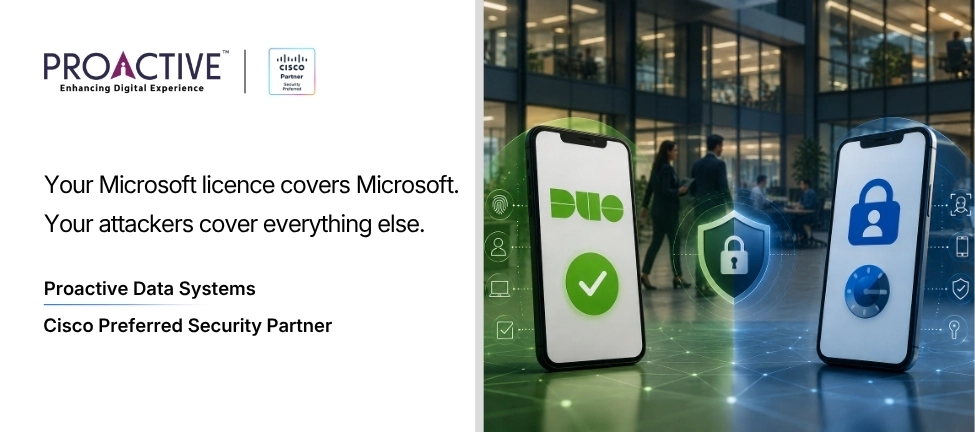
Microsoft Authenticator is the right choice if your entire application estate lives inside the Microsoft ecosystem. Cisco Duo is the right choice if it doesn't — which describes the majority of Indian enterprises. The decision turns on three questions: how mixed is your environment, how seriously do you need device trust, and how many regulatory clocks are ticking simultaneously. This piece answers all three, without the sales language.
The conversation usually starts the same way. A CISO or IT head, mid-evaluation, slightly exasperated:
"We already pay for Microsoft 365. Why would we spend more on Cisco Duo when Authenticator is essentially free?"
It is a reasonable question. It also contains an assumption that, for most Indian enterprises, turns out to be wrong.
The assumption is that "we use Microsoft 365" means "our authentication problem is a Microsoft problem." In practice, the typical Indian enterprise IT environment — a mix of cloud SaaS, on-premise ERP, a Cisco or Fortinet VPN, Linux servers, legacy applications authenticating via RADIUS, and a growing population of contractor and third-party vendor accounts — is not a Microsoft environment. It is a Microsoft-and-everything-else environment. That distinction is where the comparison actually lives.
The identity security question — which platform, how completely, and against which regulatory standard — has moved from IT infrastructure to board agenda. What follows is an assessment of both platforms as they stand in 2026, mapped to the specific regulatory, operational, and infrastructure realities of the Indian enterprise market. Neither product is superior in every situation. The goal here is to give IT decision-makers in India the information required to make the right call for their specific environment — not to arrive at a predetermined conclusion.
The question has sharpened considerably in the past six months. Microsoft enforced mandatory MFA across its Azure and Microsoft 365 admin infrastructure from October 2025. RBI's Authentication Mechanisms for Digital Payment Transactions Directions, 2025 — issued on 25 September 2025 and effective from 1 April 2026 — are pushing Indian financial institutions towards flexible, risk-based, and phishing-resistant authentication for payment transactions, moving decisively away from static SMS OTP as the sole second factor. The market has moved from "should we implement MFA" to "which MFA, for what, and is what we have actually complete."
Two developments have accelerated MFA evaluation across Indian enterprises specifically.
The first is regulatory. RBI's April 2026 directions apply to digital payment transactions — UPI, cards, net banking, wallets — and require two factors of authentication with at least one dynamic factor per transaction. Separately, RBI's IT governance and cybersecurity frameworks for banks and NBFCs require MFA for internal system access. SEBI's Cybersecurity and Cyber Resilience Framework covers capital markets entities. CERT-In's mandatory audit guidelines, effective July 2025, add authentication logging and monitoring requirements. The DPDP Act's "reasonable security safeguards" standard, read against this backdrop, makes a defensible case for MFA on every system handling personal data. The cumulative effect is a regulatory environment in which the absence of comprehensive MFA is not merely a security gap — it is an audit finding waiting to happen.
The second is Microsoft itself. In a significant policy shift, Microsoft enforced mandatory MFA for all Azure portal, Microsoft Entra admin centre, and Microsoft Intune admin centre access from October 2025. The Microsoft 365 admin centre followed in February 2026. Legacy per-user MFA policies were retired in September 2025, replaced by a unified Authentication Methods policy. Microsoft's own research puts MFA's effectiveness against automated credential attacks above 99%. The company has, in effect, decided that the question of whether enterprises should implement MFA is closed. The only remaining question is which MFA, and whether what is deployed actually covers the full authentication surface.
Microsoft Authenticator is the authenticator application that ships as part of Microsoft's identity platform, now consolidated under Microsoft Entra ID. It handles push notification approvals, TOTP code generation, passwordless phone sign-in, and passkey storage. It is available for iOS and Android, integrates natively with Azure AD Conditional Access, and supports number-matching push notifications — Microsoft's equivalent of Duo's Verified Push — which became the default for Entra ID MFA in 2023.
The cost question requires precision. Microsoft Authenticator, as a standalone application, is free to download. The enterprise MFA capability it enables, however, depends on the Entra ID tier underneath it.
Microsoft Entra ID Free — included with any Microsoft 365 subscription — provides basic MFA via Authenticator, SMS, and voice call. It does not include Conditional Access, meaning you cannot build access policies based on device compliance, user risk, or application sensitivity. It does not include risk-based sign-in analysis. It does not include device compliance enforcement.
Microsoft Entra ID P1 — included in Microsoft 365 Business Premium, E3, and available standalone at approximately $6 per user per month — adds Conditional Access, enabling policy-based MFA enforcement, device compliance requirements, and location-based controls. This is the tier that makes Microsoft's MFA genuinely enterprise-capable.
Microsoft Entra ID P2 — included in Microsoft 365 E5, standalone at approximately $9 per user per month — adds Identity Protection: AI-driven risk scoring for users and sign-ins, automatic remediation for risky sign-ins, and privileged identity management. This is Microsoft's most complete identity security offering.
The practical implication for Indian enterprises: if you are on Microsoft 365 Business Premium or E3 and above, you have Entra ID P1 included, and Conditional Access MFA is available at no additional licensing cost for Microsoft applications. If you are on E1 or a basic plan, your MFA capability without additional licensing is limited in ways that matter for enterprise security.
Cisco Duo is a cloud-delivered access security platform. Its primary function is MFA, but it is more accurately described as a zero-trust access enforcement layer — it verifies identity, assesses device posture, and applies adaptive access policies across any application, regardless of vendor, protocol, or hosting environment.
Duo protects VPN (Cisco, Palo Alto, Fortinet, Check Point and others), cloud applications (Microsoft 365, Google Workspace, Salesforce, SAP, Workday), on-premise applications via RADIUS or LDAP proxy, remote desktop and SSH access, and custom applications via API. It also integrates as an external MFA provider within Microsoft Entra Conditional Access — meaning Duo can layer on top of a Microsoft environment rather than replace it.
Microsoft's own research indicates that MFA blocks over 99% of automated credential attacks — a figure that has made MFA mandatory rather than advisory in Microsoft's own service policies from October 2025 onwards. Cisco Duo delivers this protection across environments that extend well beyond what Microsoft Authenticator can natively reach.
Cisco has operated a dedicated Duo data centre in Mumbai since May 2022, launched specifically to address Indian data localisation requirements. The facility is ISO 27001 and SOC 2 certified and targets 99.999% availability. Indian enterprises that require authentication data to be stored and processed within India can configure their Duo deployment to use this data centre. For GCCs under global compliance mandates, BFSI organisations interpreting RBI data localisation guidance, and enterprises subject to DPDP Act data handling obligations, this is a named, operational capability — not a gap.
Duo Essentials — MFA across any application, Duo Push, TOTP, basic device visibility. Entry point, but lacks device trust enforcement. Approximately $3–4 per user per month at list price.
Duo Advantage — adds adaptive authentication, device health checks (OS currency, encryption status, endpoint protection presence), risk-based policies, and the ability to block access from non-compliant devices. The recommended enterprise baseline. Approximately $6–9 per user per month.
Duo Premier — adds full SSO, passwordless authentication, certificate-based device trust (Trusted Endpoints), and deep integration with Cisco Secure Access for zero trust network access. Approximately $9–12 per user per month.
In India, Duo is purchased through the Cisco partner channel, invoiced in INR at prevailing exchange rates. Volume discounts apply from 500 users and are meaningful at 1,000 users and above. Three-year terms improve per-user economics significantly.
According to Cisco's 2025 Cybersecurity Readiness Index, only 7% of Indian organisations have achieved mature cybersecurity readiness. Device trust — verifying not just who is logging in but what they are logging in from — is one of the least deployed capabilities among the remaining 93%. Duo Advantage addresses this directly.
Comparison articles typically produce long feature matrices that obscure more than they reveal. In the Indian enterprise context, three differences are genuinely determinative.
This is where the comparison is decided for most Indian organisations.
Microsoft Authenticator is purpose-built for the Microsoft ecosystem. Its native integration with Entra ID is seamless and deep. For applications that support SAML federation or are registered as Entra ID enterprise applications, it works without friction. The challenge is everything outside that boundary.
A typical Indian enterprise IT environment includes applications that predate cloud, applications built on-premise that authenticate via RADIUS or LDAP, VPN infrastructure from Cisco or Palo Alto, Linux servers accessed via SSH, ERP systems running on-premise, and legacy line-of-business applications whose vendors have not issued a SAML update in years. None of these is natively protected by Microsoft Authenticator without significant architectural work or the additional deployment of Entra's Application Proxy, which carries its own configuration and licensing considerations.
Cisco Duo addresses this through the Authentication Proxy — a lightweight Windows service that intercepts RADIUS and LDAP authentication requests from any application and adds a second factor without requiring application changes. The practical outcome: a Pune-based manufacturer can deploy Duo and protect its Cisco VPN, its on-premise ERP, its Microsoft 365 environment, its Linux production servers, and its custom applications, all from a single policy console. The same organisation attempting equivalent coverage with Microsoft Authenticator alone would find several of these applications outside the protection boundary.
The test to apply: list every application and system in your environment that requires authenticated access. Classify each as natively Azure AD-integrated, SAML-capable, or neither. If more than 20% fall into the "neither" category — which is the majority of Indian enterprise environments with any on-premise infrastructure — Microsoft Authenticator's coverage will be incomplete.
Both platforms offer device trust capabilities. The implementation differences matter for Indian enterprises with heterogeneous device fleets.
Microsoft's device compliance in Conditional Access is powerful and well-integrated — for devices enrolled in Microsoft Intune. Windows laptops managed by Intune receive the full compliance checking stack: OS version, encryption status, endpoint protection, and jailbreak detection. For organisations running a predominantly Intune-managed Windows fleet, this is genuinely strong.
The gaps appear at the edges. Linux endpoints — common in Indian IT services and GCC environments where development teams run Ubuntu or RHEL — are not fully supported by Intune compliance policies. Devices that are not enrolled in Intune — personal devices, contractor laptops, devices managed by a different MDM — fall outside Microsoft's device trust framework. In an Indian enterprise where contractors may outnumber employees on some projects, and where BYOD is common rather than exceptional, these gaps are significant.
Cisco Duo's device trust operates differently. The Duo Device Health application — a lightweight client installed on endpoints — reports security posture directly to Duo regardless of MDM enrolment. Duo Advantage enforces device health checks across Windows, macOS, Linux, iOS, and Android, and can assess posture on devices not enrolled in any MDM. Duo Premier adds certificate-based Trusted Endpoints for the highest-assurance environments.
The practical outcome: an Indian IT services firm whose developers work on personal Linux machines, a GCC whose contractor population connects from unmanaged devices, or an NBFC where field staff access systems from personal phones — all face device trust gaps that Duo addresses more comprehensively than Microsoft Authenticator alone.
Indian enterprises in regulated sectors face a specific problem that global comparison articles do not address: the audit evidence requirement.
RBI inspectors, SEBI auditors, and ISO assessors reviewing access control ask a specific set of questions. Is MFA enforced on all systems that access sensitive data? Does device compliance checking extend beyond managed corporate devices? Can you demonstrate that contractor access is subject to the same authentication requirements as employees? Can you produce authentication logs for a specific user, application, and date range on request?
Both platforms produce authentication logs. Both support MFA enforcement. The difference is in the breadth of coverage that can be demonstrated.
For a BFSI organisation with a mixed environment — core banking on-premise, Microsoft 365 in the cloud, a Cisco VPN, and a population of contractor accounts — demonstrating to an RBI inspector that MFA covers all of these from a single policy and reporting framework is cleaner with Duo than with Microsoft Authenticator's coverage limited to the Azure AD perimeter.
RBI issued Rs 54.78 crore in penalties to 353 regulated entities in FY 2024-25 for cybersecurity and compliance failures. The organisations penalised were not ones without documentation. They were ones whose documentation did not match their operational reality. A partially deployed MFA architecture, where the VPN or the on-premise core banking access remained unprotected, is precisely the gap that produces that divergence.
A precise mapping of where each platform stands against the regulatory frameworks most relevant to Indian enterprises.
RBI Authentication Mechanisms Directions 2025 (April 2026) — payment transactions: Both platforms support the phishing-resistant and risk-based authentication factors that RBI's directions encourage for digital payment transactions. The directions apply to payment system providers and participants — banks, NBFCs, wallet operators, payment gateways — for consumer-facing payment authentication. This is a different compliance layer from internal employee access controls, though they often share infrastructure.
RBI IT Governance and Cybersecurity Frameworks — internal system access: RBI's Master Direction on IT Governance requires MFA for employee access to sensitive banking systems. Duo's broader application coverage means a more complete compliance posture for mixed-environment BFSI organisations where internal systems span on-premise core banking, VPN access, and cloud platforms simultaneously.
DPDP Act "Reasonable Security Safeguards": Either platform satisfies the authentication component if deployed comprehensively. The completeness of deployment — covering all systems holding personal data, not just the Microsoft perimeter — is what "reasonable" requires in practice. Duo's broader coverage is an advantage for organisations with non-Microsoft applications handling personal data, particularly where post-breach liability will turn on demonstrating that all access points were controlled.
SEBI CSCRF: Requires MFA for access to critical systems and market data platforms, with audit trail requirements. Both platforms satisfy this for systems within their respective coverage boundaries. Mixed environments again favour Duo on completeness of coverage.
CERT-In Audit Guidelines: Require authentication event logging and retention. Both platforms produce exportable logs compatible with SIEM integration — Cisco Splunk, Microsoft Sentinel, and IBM QRadar. No material differentiation here.
SOC 2 / ISO 27001 (for GCCs and IT/ITeS): Both platforms satisfy the access control requirements of both frameworks when correctly deployed and documented. The documentary advantage of a single-platform deployment covering all applications — possible with Duo in mixed environments — simplifies the audit evidence production that GCCs under pressure from global parent companies need to deliver.
The short answer: Microsoft Authenticator is the right choice for organisations whose entire application estate is natively integrated with Azure AD. Cisco Duo is the right choice for organisations with any on-premise applications, non-Microsoft SaaS, VPN infrastructure from Cisco or Fortinet, Linux endpoints, or significant contractor access — which describes most Indian enterprises with any legacy or mixed infrastructure. For regulated sectors in India, Duo's broader application coverage, India-based data centre, and single-platform audit trail produce a more complete compliance posture against RBI, SEBI, and CERT-In requirements. Both platforms support phishing-resistant MFA. The difference is coverage breadth, not authentication strength.
| Factor | Cisco Duo | Microsoft Authenticator |
|---|---|---|
| Native Microsoft 365 / Entra ID integration | Strong — via SAML, OIDC, or as external MFA provider | Native |
| Non-Microsoft SaaS application coverage | Broad — pre-built integrations for Salesforce, SAP, Workday, Google Workspace and hundreds more | Limited to Azure AD-integrated or SAML-capable applications |
| On-premise application coverage | Via Authentication Proxy — no application changes required | Via Entra Application Proxy — additional configuration required |
| VPN MFA (Cisco, Palo Alto, Fortinet) | Native integrations across all major vendors | Requires RADIUS configuration; no native VPN partnerships |
| Linux endpoint device trust | Supported via Duo Device Health app | Limited Intune support for Linux |
| Non-Intune / unmanaged device trust | Supported via Duo Device Health — no MDM required | Requires Intune enrolment |
| Verified Push / Number matching | Verified Push — default since 2023 | Number matching — default since 2023 |
| FIDO2 / Passkeys | Supported natively | Supported natively |
| Adaptive access policies | Duo Advantage and above | Entra P1 Conditional Access |
| Risk-based authentication | Duo Advantage — Cisco Identity Intelligence | Entra P2 Identity Protection |
| SSO across all applications | Duo Premier | Entra ID — Microsoft applications natively; others via federation |
| India data centre | Mumbai data centre operational since 2022 — ISO 27001, SOC 2 certified | India region available for certain Entra data types |
| Pricing basis | Per user, per year — transparent list pricing | Bundled with Microsoft 365 licence tiers; P1/P2 for enterprise capability |
| Compliance reporting | Authentication logs; compliance reports; single-pane coverage across mixed environments | Authentication logs via Entra; SIEM export available |
| Suitable environment | Mixed — Microsoft and non-Microsoft | Predominantly Microsoft |
Choose Microsoft Authenticator if:
Your entire application estate — every application requiring authenticated access — is natively integrated with Azure AD or is SAML-capable and already federated with Entra. Your device fleet is predominantly Windows, enrolled in Intune. You have no significant on-premise application infrastructure authenticating via RADIUS or LDAP. Your contractor and third-party vendor population is small and manages access exclusively through Microsoft-integrated applications. You are on Microsoft 365 E3 or Business Premium and above, giving you Entra P1 Conditional Access included.
In this scenario, Microsoft Authenticator with Conditional Access is a strong, cost-effective solution and adding Cisco Duo introduces complexity without proportionate benefit.
Choose Cisco Duo if:
Your environment includes non-Microsoft applications — cloud SaaS, on-premise ERP, legacy line-of-business applications — not natively Azure AD-integrated. You have VPN infrastructure from Cisco, Palo Alto, Fortinet, or another vendor. You have on-premise applications authenticating via RADIUS or LDAP. Your developer or engineering population includes Linux users. You have significant contractor or third-party vendor access that needs to meet the same MFA and device trust requirements as employees. You are in a regulated sector — BFSI, IT/ITeS with SOC 2 requirements, GCC under global compliance mandates — where demonstrating comprehensive access coverage across all systems is an audit requirement.
For organisations building a zero trust access architecture in India, Duo Premier's integration with Cisco Secure Access extends identity verification to network-level access control — a capability Microsoft Authenticator alone does not provide.
The majority of Indian enterprises with any on-premise infrastructure, any non-Microsoft SaaS, or regulated compliance obligations will find themselves in this column.
Consider both if:
Your organisation is Microsoft-heavy but has specific gaps — Linux engineering endpoints, a Cisco VPN, or legacy applications outside the Azure perimeter. Microsoft Entra ID's External Authentication Methods capability, now generally available, allows Duo to act as the MFA provider for Entra-authenticated access. Users see the Duo push in Duo Mobile when authenticating to Microsoft applications. Duo's device trust and adaptive policies apply across the full environment.
This hybrid architecture is increasingly common in Indian enterprises that want the operational breadth of Duo alongside the native integration of Microsoft's identity platform. It requires careful configuration — users will see an additional prompt to select Duo rather than the seamless auto-push experience of a native Duo deployment, and session management in Entra needs to be reviewed before choosing this architecture. A deployment partner who has done this before should walk through the implications.
The "Authenticator is free" argument deserves a direct response.
Microsoft Authenticator's MFA capability at enterprise-grade requires Entra ID P1, included in Microsoft 365 Business Premium and E3. If your organisation is already on these tiers — and most Indian mid-market enterprises with 200 or more users are — the marginal cost of enabling Authenticator MFA for Microsoft applications is near zero.
The cost comparison changes when you account for coverage completeness. Protecting a mixed environment with Microsoft Authenticator requires Entra P1 at minimum, often Entra Application Proxy configuration for on-premise applications, and potentially custom RADIUS configuration for VPN. Some applications will remain outside the coverage boundary without bespoke development work. The engineering hours involved in achieving equivalent coverage to a Duo deployment are not zero.
Cisco Duo Advantage at $6–9 per user per month adds cost against a Microsoft baseline. What it removes is the engineering effort required to extend Microsoft's coverage to non-native applications, the coverage gaps that would otherwise exist, and the audit complexity of defending a partial deployment to an RBI inspector. For a regulated Indian enterprise with a mixed environment, the total cost of ownership argument for Duo is stronger than the per-user licence comparison suggests.
The Duo versus Microsoft Authenticator question resolves differently for different organisations, and the honest answer is that both are strong products in the environments they are designed for. The error is applying either without mapping your actual application estate first.
We have been deploying identity security infrastructure across Indian enterprises since 1991. The most consistent outcome of an honest application inventory is this: the organisation has more non-Microsoft, non-Azure-integrated applications than its IT team initially estimates, because a comprehensive inventory has never been done. When it is done, the coverage gap that Microsoft Authenticator alone would leave is larger than expected.
The second most consistent finding: the VPN. Almost every Indian enterprise has one. Almost none are running Microsoft VPN infrastructure. Protecting the VPN with phishing-resistant MFA is a specific requirement under RBI's IT governance framework and a direct CERT-In recommendation. It is where Duo's native integration delivers immediate, defensible coverage.
We work with mid-market and enterprise organisations across BFSI, manufacturing, IT/ITeS, and GCC sectors to assess the authentication surface, identify the gaps, and deploy the right solution. For some organisations, the right answer is Microsoft Authenticator with Conditional Access. For most, given India's infrastructure realities, it is Duo alone or alongside Microsoft's identity platform.
If you would like an honest assessment of which is right for your environment, that is where we start.
Proactive Data Systems has been deploying enterprise IT infrastructure and security solutions across India since 1991. We are a Cisco Preferred Security Partner — and one of fewer than a handful in India to hold a Preferred designation across Security, Networking, Collaboration, Cloud & AI, and Services.

Proactive Cybersecurity Team
We'll get back to you shortly.
